
When a returned parcel arrives at your warehouse you have already paid the refund. The next actions decide whether the returned parcel becomes a loss or turns into a sale. In 2026, returns are routine in online selling, so handling them well matters as much as shipping well.
For Amazon FBA sellers, multi-channel brands, prep centers, and 3PL teams, the refund is rarely the biggest cost. The bigger cost is the days a sellable unit sits unopened and unlisted. Ecommerce fulfillment software fixes this by giving each return a status, a grading rule, and a path back to inventory.
This guide shows where returns cost you money. It explains how a strong workflow fixes each gap and what to look for in a platform.
Why returns hurt margins more than most sellers expect
Many sellers treat returns as a customer service task. The team issues a refund, sends an email, and leaves the parcel for whoever has time. The financial damage happens in the warehouse, where every unit awaiting inspection is stock you own but cannot sell.
The National Retail Federation reported that shoppers returned an estimated 19.3% of online sales in 2025. That is roughly one in five orders. Each one carries return shipping, handling labor, and lost time before the item can earn revenue again.
Returns also strain the rest of your operation. Available stock looks lower than it is, and listings go out of stock early. Your team then spends hours matching returned items to the right orders and SKUs.
Where returns drain your margin
Most losses happen only after the package arrives, not from the refund. Five gaps show up often in operations that manage returns by using spreadsheets, email threads and memory.
- Slow receiving. No one owns the return queue, so parcels sit for days and sellable stock stays off the market.
- Inconsistent grading. Two team members inspect the same item and disagree. That leads to wrong refunds and wrong restocking decisions.
- Mismatched records. Staff scan a returned unit against the wrong SKU or FNSKU. Inventory counts then drift from what sits on the shelf.
- Delayed restocking. Good units wait to return to the shelf while the listing shows as out of stock.
- Weak fraud visibility. Empty boxes, swapped items, and repeat abusers go unnoticed when no one can see return history by customer or SKU.
Why the return pile is an inventory problem
A return is not a finished order. It is inventory moving between sold and sellable. Unless your system tracks that state, the unit is invisible.
Sellers then see fewer available units than they own. Marketplace listings go out of stock, and cash sits in unopened boxes.
What ecommerce fulfillment software changes about returns
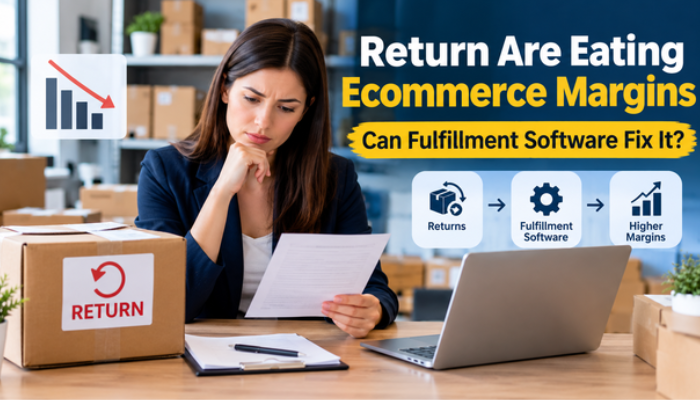
A strong returns workflow follows four steps. Name the problem, find the operational cause, apply a fixed process, and measure the result.
A good fulfillment platform gives every return a status from the moment you create the return label. Your team can see what is in transit, what has arrived, what awaits grading, and what is back in stock. That single view replaces guesswork on the returns desk.
It also makes grading repeatable. Instead of relying on individual judgment, your team follows set disposition rules: restock, refurbish, liquidate, or discard. The system logs each decision, which helps with refund disputes and with spotting patterns by product or supplier.
The payoff shows up in three places. Faster receiving puts sellable units back on sale sooner. Consistent grading reduces refund errors. Accurate records keep inventory counts reliable.
A worked example
Take a multi-channel seller in New Jersey that ships about 2,000 orders a month across Amazon and Shopify. At the 19.3% online average, that seller handles about 386 returns a month. Suppose half of those units are sellable and each waits nine days for inspection.
That leaves close to 200 units off the market for more than a week every month. A workflow that receives, grades, and restocks within two days puts that stock back on sale a full week sooner. This scenario uses a public average and is not a customer case. The math holds for any seller with similar volume.
Why multi-channel returns need one queue
Returns rarely come through one channel. An Amazon FBA return, a Walmart WFS return, and a Shopify return follow different rules. They often land in the same warehouse. When each channel has its own spreadsheet, no one sees total returned inventory.
Multi-channel ecommerce software pulls every return into one queue. It matches each return to the right SKU and sales channel. Ecommerce operations software then connects that queue to inventory counts, so restocked units return to available stock on every channel.
PrepShipHub built its “Returns & Problems” workflow around this idea. Your team receives the return, grades it, and routes it to the right outcome from one screen. The design came from real fulfillment operations, where the return pile was a daily frustration.
A five-step returns workflow to set up this quarter
You do not need a full system overhaul to begin. These steps work in most operations and give you a baseline to measure.
- Create a return record for every authorized return, so your team knows what is coming before it arrives.
- Scan each returned unit against its SKU on arrival, and log the receiving date.
- Apply written grading rules with fixed outcomes: restock, refurbish, liquidate, or discard.
- Sync restocked units to available inventory on every channel the same day.
- Review returns by SKU every month, and flag products with unusually high return rates.
Metrics that show your returns process is working
A workflow only helps if you can measure it. Track these five numbers monthly, and use your platform’s reports to check trends by channel.
- Receive-to-restock time. The average days between a return arriving and the unit becoming sellable again.
- Grading turnaround. The share of returns your team grades within 48 hours of arrival.
- Inventory accuracy after returns. The gap between system counts and physical counts for returned SKUs.
- Return rate by SKU. The products that come back most often, and the reasons customers give.
- Recovery value. The share of returned units that sell again at full price instead of at a markdown.
Most ecommerce operations software reports these numbers by default. Compare each channel separately. Multi-channel ecommerce software should show Amazon, Walmart, and Shopify returns side by side. If your tool cannot do this, its designers likely built it around outbound orders only.
What to ask before you choose a fulfillment platform for returns
Feature lists rarely show how a platform handles returns at real volume. Ask the vendor to walk through one return from label to restock. Watch for these details.
- Can the system track a return before it arrives, or only after your team scans it?
- Does grading follow configurable rules, and does the system log each decision?
- Does the multi-channel ecommerce software connect Amazon, Walmart, Shopify, and eBay into one returns queue?
- Do restocked units update connected marketplace inventory automatically?
- Can the system separate returns by client if you run a prep center or 3PL operation?
- Does reporting show return rates by SKU, channel, and reason?
A vendor that answers these in a live demo will likely hold up in a busy return season. A vendor that only shows a dashboard may not.
Turning returns into a controlled process
Returns will not disappear, and they will stay a fixed part of selling. Three things stay in your control: receiving speed, grading consistency, and how fast good stock goes back on sale. Ecommerce fulfillment software makes each of those steps visible and measurable.
PrepShipHub is ecommerce operations software from fulfillment operators who lived with these problems. Its all-in-one platform brings returns, inventory, shipping, and reporting into one system.
Book a demo of PrepShipHub to see how returns processing works alongside inventory and multi-channel fulfillment.
Frequently asked questions
What is fulfillment software?
Fulfillment software is a platform that manages inventory, orders, shipping, and returns across sales channels. It gives sellers and warehouses one system to track stock and process orders from receiving to delivery.
Can fulfillment software reduce the number of returns?
It cannot stop customers from returning items, but it lowers the cost of each return. Return reports by SKU show which products cause the most returns, so sellers can fix the source.
What is a normal return rate for online sales?
The National Retail Federation said that shoppers returned 19.3 percent of sales in 2025. The return rates differ a lot depending on the product type. I think you should look at your own numbers next, to sellers who sell similar items.
How does returns processing work in a fulfillment system?
The system creates a record for each return and tracks it to your warehouse. Your team scans it on arrival and grades the item. The software then routes it to restock, refurbish, or disposal and updates inventory.
